Are you attending?
Event Details
Welcome to La Folle Journée 2027 in Nantes
La Folle Journée is Nantes’ flagship classical festival: short concerts, low prices, a near-continuous timetable. The 33rd edition runs from 27 to 31 January 2027 – Wednesday to Sunday, as usual. The theme is “Galaxie Beethoven”, marking 200 years since Ludwig van Beethoven’s death in 1827. Pianist Vanessa Wagner is artistic director. The event is produced by Cité des Congrès de Nantes (5 Rue de Valmy, 44000 Nantes) with the city and the metropolis.
The formula is unchanged: concerts of about 45 minutes, several halls at once, morning to night. In 2026 (“Les Fleuves”, 28 January–1 February) some 132,000 people heard around 300 concerts by 2,380 artists. For 2027 the 2,000-seat Auditorium 2000 is closed for renovation, so the map spreads across the city: Le Lieu unique, Théâtre Graslin, Chapelle de l’Oratoire, Musée d’arts, the Conservatoire and more. The official site lists 27–31 January 2027 as the core dates; May 2026 press mentioned a possible extension from 22 January. Treat follejournee.fr as the source of truth.
Highlights & Attractions at La Folle Journée in Nantes
- Five packed days and roughly 300 concerts of about 45 minutes – enough to hear three, four or five programmes in a single day.
- 2027 theme: Galaxie Beethoven – the famous works, lesser-known pages, and his pull on later composers, popular culture, art and science.
- Artistic direction by Vanessa Wagner, the first “artiste invitée” in the new festival model after founder René Martin’s departure.
- Deliberately cheap tickets: in 2026 seats were 0–29 EUR (39 EUR only for the Arte concert), with 10,000 school places at 6 EUR. 2027 prices go public with ticketing on 5 December 2026.
- Free concerts at the Grande Halle kiosk – the festival’s open heart, mixing amateur groups and headline names.
- A city-wide 2027 geography: without the big auditorium, music moves into historic and contemporary rooms across Nantes.
- Family, school and accessibility offers (audio description, wheelchair seats, companion rates) plus free TAN city transport on your concert day.
Find Accommodation in Nantes
Compare the best hotel prices for this event and secure your accommodation in time.
Free cancellation on most hotels
Program & Schedule: What to Expect in 2027
The title quotes Beaumarchais’ “Le Mariage de Figaro ou la Folle Journée” – and Mozart’s “Figaro”, the 1995 founding theme. The point is still classical music without a pedestal. Concerts typically start around 9:30 or 10:00 and run until about 22:00, with as little as 15 minutes to change rooms. A well-planned day stacks chamber music, orchestra, song and piano. The paper programme usually appears in December at partner shops and the Cité des Congrès; the online grid goes live on follejournee.fr once the season is released. Full 2027 listings were not yet complete in September 2026.
Beethoven is the centre of gravity, not a marble bust. Wagner wants the famous symphonies and sonatas beside intimate, rarely heard pieces, and established names beside new faces. Expect piano recitals, string quartets, orchestral programmes (including Orchestre National des Pays de la Loire), conservatoire and youth ensembles, plus lines to Beethoven’s pupils, Romantic heirs and present-day arrangements. Exact casts follow the official brochure. There is usually a professional day, family formats and concerts in the wider metropolis, plus – often the weekend before – satellite events in Pays de la Loire towns such as Saint-Nazaire, the Angers area, La Roche-sur-Yon, Laval and Saumur.
Cité des Congrès and the Grande Halle – the hub in Nantes
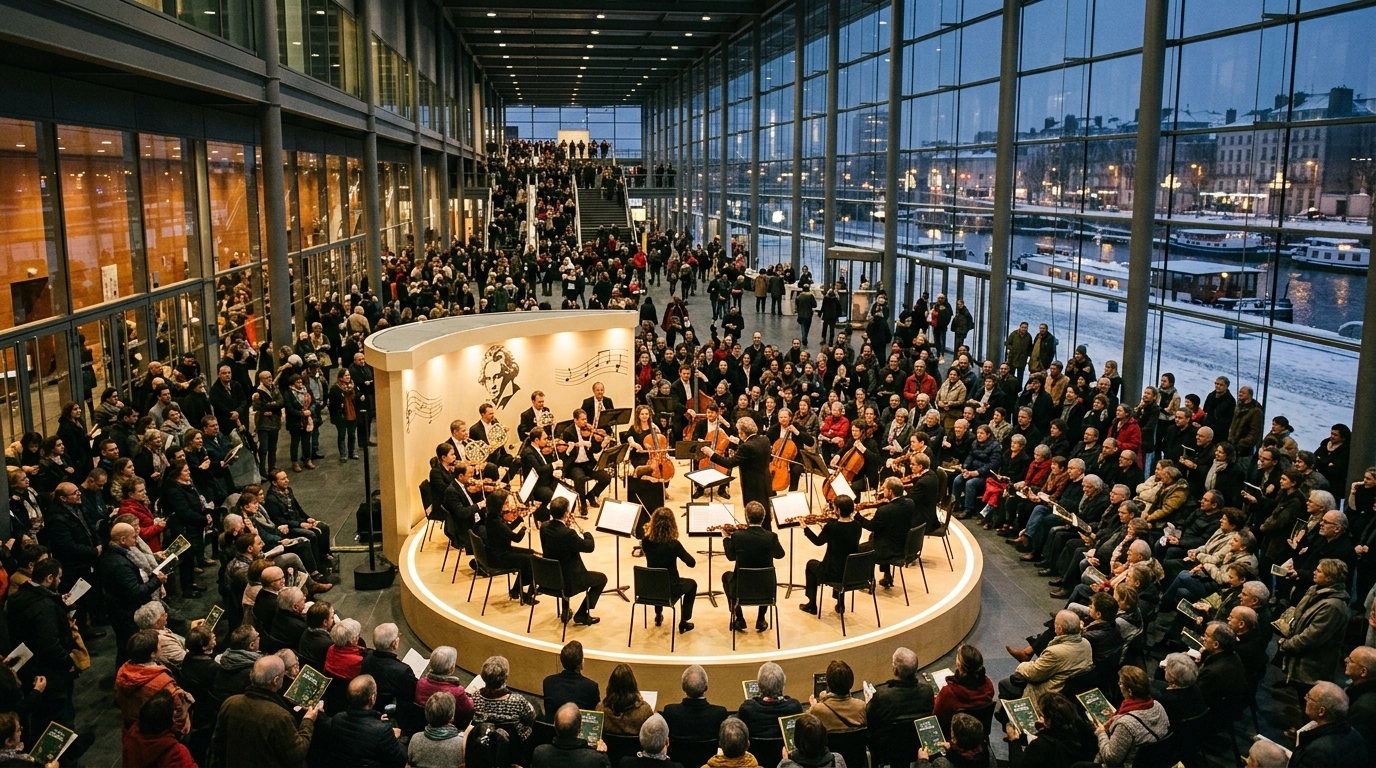
Cité des Congrès remains the 2027 anchor, even without Auditorium 2000. The glass Grande Halle holds the kiosk: an open stage, often free, and the place you bump into friends between paid concerts. Smaller auditoriums take the core billed programme. The complex sits on Canal Saint-Félix, a short walk from Nantes station. Works close the grand auditorium from July 2026; the full hall shuts only after the festival, from February 2027. That makes 2027 the last edition before the building’s long pause – and the reason music spills into the city.
Théâtre Graslin – opera-house Beethoven in Nantes
The neoclassical Théâtre Graslin on Place Graslin is one of the houses Wagner wants to pull into 2027. Beethoven feels more theatrical here than in a congress hall: a natural fit for song, chamber music and smaller orchestral forces. Around the square you get Brasserie La Cigale, Passage Pommeraye and the pedestrian centre – useful for a meal without breaking the festival rhythm.
Le Lieu unique – Nantes’ cultural biscuit factory
In the former LU biscuit works on Canal Saint-Félix, a three-minute walk from the Cité, La Folle Journée has played since 2012. The industrial building with its tower and bookshop gains extra weight in 2027: contemporary rooms for less canonical Beethoven, crossover and formats that would sit oddly in a velvet auditorium. Bar, bookshop and lookout tower make it a natural pause between concerts.
Chapelle de l’Oratoire and Musée d’arts de Nantes
The Oratoire chapel and the Musée d’arts are among the “other geographies” Wagner has promised. Stone and resonance suit piano and voice in the chapel; the museum can pair programmes with visual art, in line with the 2027 aim to cross Beethoven with the arts and sciences. Both are walkable from the old town and the Château des Ducs de Bretagne. Exact slots will follow the official timetable.
Conservatoire de Nantes and metropolitan stages
The Conservatoire is a regular partner: student ensembles, saxophone massed groups, choirs and the Orchestre métropolitain play in the Cité and in the hall. In 2027, with professional capacity cut by the closed auditorium, training orchestras will be more visible. Concerts also land in metro towns (Espace Capellia in La Chapelle-sur-Erdre in 2026). If you stay outside central Nantes, check the day-by-day grid for suburban options.
La Folle Journée across Pays de la Loire
Before or beside the Nantes week, the format tours the region: historically Saint-Nazaire, Cholet, Challans, La Roche-sur-Yon, Fontenay-le-Comte, Laval, Sablé-sur-Sarthe, La Flèche, Saumur, L’Île-d’Yeu and Fontevraud. Satellites use the same short-concert model at local prices. 2027 municipal dates usually appear in autumn on follejournee.fr. For rail travellers from Angers, Le Mans or La Roche-sur-Yon they can be an easier first taste before the full Cité density in Nantes.
Sister festivals: Tokyo, Bilbao, Warsaw
The idea has travelled since 2002. La Folle Journée Tokyo (Tokyo International Forum, around the station) is listed for 3–5 May 2027, often with a related yearly theme. Bilbao runs it as Musika-Música; tour operators flag early March 2027 (4–8 March) as festival week. Warsaw (Sinfonia Varsovia / Teatr Wielki) is typically in September. Lisbon hosted an earlier edition. If Nantes 2027 is full, the same 45-minute spirit lives in those cities – thematically close to the Loire edition, but independently organised.
Tickets & Admission for La Folle Journée Nantes
Official ticketing for Nantes 2027 opens on Saturday 5 December 2026 at 9:00 on follejournee.fr. 2027 prices had not been published as of September 2026. 2026 guide: 0–29 EUR per concert, 39 EUR only for the Arte concert, reduced and solidarity seats, 10,000 school tickets at 6 EUR, and free kiosk concerts in the Grande Halle. There is no all-day festival pass; you book individual concerts (usually several at once). Last season about 91,000 tickets sold on day one – be online early, especially as 2027 is expected to offer around 120,000 seats instead of about 140,000 after the auditorium loss. The metropolitan Carte blanche was accepted in 2026. Wheelchair seats and audio description: [email protected] or +33 2 51 88 21 50. An official resale channel (Reelax Tickets in 2026) is usually announced after the first sale. Switchboard: +33 2 51 88 21 99, [email protected].
Visitor Tips: Travel & Accommodation in Nantes
- Getting there: TGV to Nantes (about two hours from Paris Montparnasse), then walk along Canal Saint-Félix to Cité des Congrès. Busway line 4 stops at the door; tram line 1 (Duchesse Anne – Château) is a four-minute walk. A valid concert ticket gives free TAN city travel that day (not airport shuttle, TER or P+R). Regional rail: 2026 offered a 5 EUR Aléop Live ticket in Pays de la Loire (SMS “FJ” to 93800) – recheck ter.sncf.com for 2027.
- Weather and clothing: late January in Nantes is wet and windy, rarely a deep freeze. Wear sturdy shoes for hops between the hall, Graslin and Lieu unique, plus a light down jacket and scarf. There is no dress code – jeans sit next to jackets.
- Where to stay: hotels around Gare Sud, Île de Nantes and Bouffay are walkable. 120,000 tickets over five days fill rooms – book as soon as you buy tickets in December. Alternatives: flats in Trentemoult (ferry) or a base in Angers with a commuter train. The festival site lists partners under “Accommodations”.
- Eating between concerts: 15-minute gaps demand proximity. The Cité has catering; Graslin has La Cigale and brasseries; Lieu unique has its own kitchen. If you want a sit-down meal, leave a longer gap at lunch or after 18:00.
- Pacing: four paid concerts plus one hall kiosk is a sane daily maximum. Families should use mornings and the kiosk; specialists stack piano and quartet. The Château des Ducs, the Machines de l’île and Passage Pommeraye are good fillers when a slot stays empty.
Note: The information on this page was researched at the time of writing and may have changed since then (e.g. date, venue, or program). Visit the organizer's official website →
The photo used is illustrative and does not necessarily depict the actual event.