Are you attending?
Event Details
The Bull Festival of Agia Paraskevi – An Ancient Ritual on Lesvos
In the heart of the island of Lesvos, in the agricultural village of Agia Paraskevi, one of Greece's most ancient and distinctive folk celebrations takes place every year in late June or early July: the Bull Festival in honour of Saint Haralambos (Greek: Πανηγύρι του Ταύρου). Documented since 1774, the festival uniquely weaves together pre-Christian sacrificial customs and Orthodox Christian devotion into a three-day communal celebration that draws thousands of visitors from across Greece and beyond.
The ritual takes place at the chapel of Saint Haralambos, set in a pine forest on the hillside above the village. Saint Haralambos is venerated as the protector of farmers and livestock breeders, and the festival reflects the deep bond between this farming community and the natural world.
Program and Rituals
The Bull Festival lasts three to four days and centres on a sequence of rituals and communal celebrations passed down through generations:
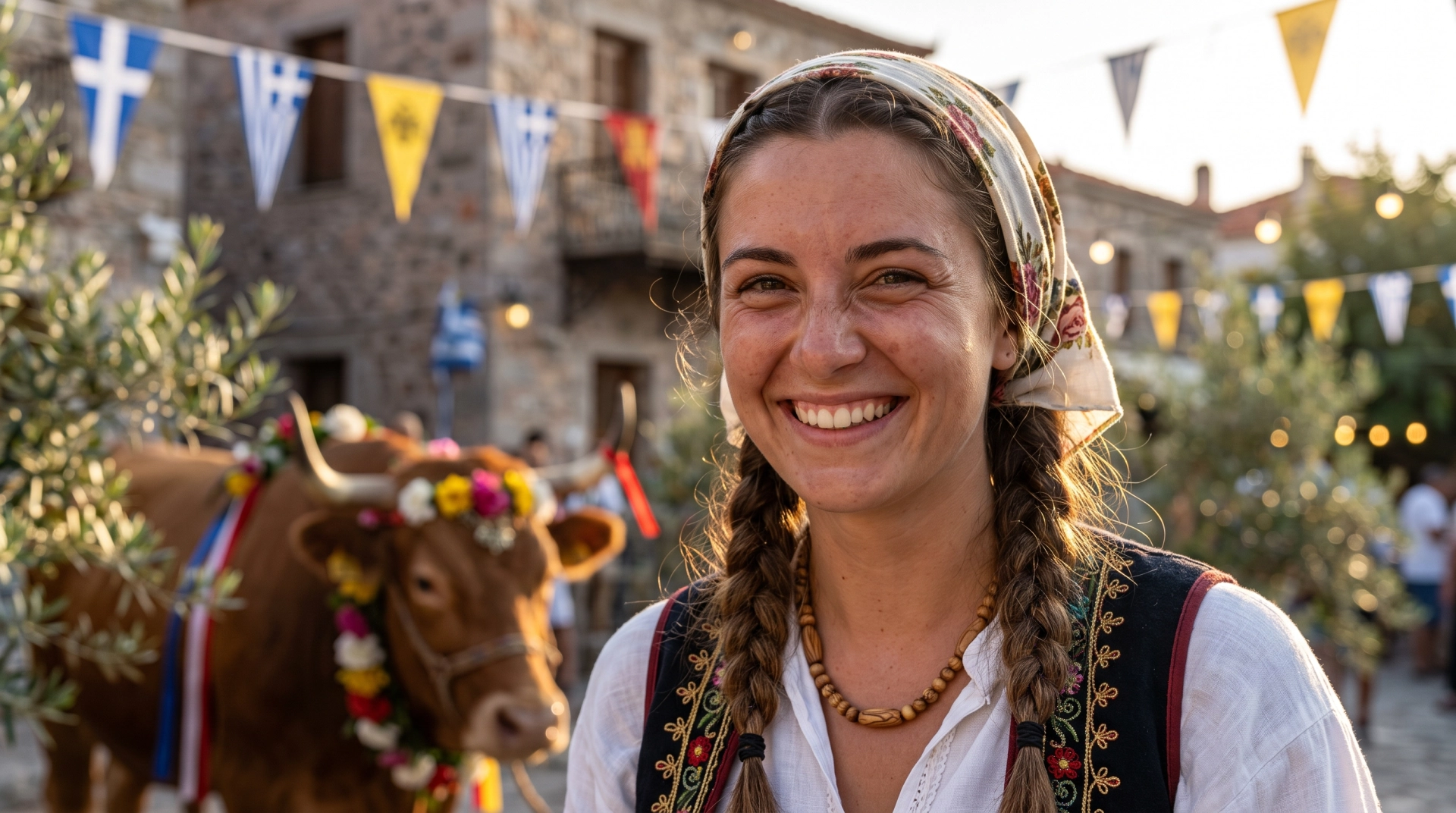
- Decoration of the bull: A healthy bull is adorned with flower wreaths and colourful decorations and paraded ceremonially through the village.
- Ritual sacrifice: The bull is offered as a sacrifice to Saint Haralambos. The meat is used to prepare the traditional dish Kiskek (also Keskeki), a slow-cooked wheat and meat porridge with roots in Asia Minor cuisine.
- Communal feast: The Kiskek is distributed free of charge to all those present. Thousands of visitors from across the island share in this communal meal.
- Horse racing and equestrian parade: Decorated horses and their riders take part in processions and equestrian contests, one of the festival's most spectacular moments.
- Folk dancing and live music: The village square comes alive throughout the night with traditional Greek music and dancing.
Find Accommodation in Agia Paraskevi
Compare the best hotel prices for this event and secure your accommodation in time.
Free cancellation on most hotels
Background: Pagan Roots and Christian Tradition
The Bull Festival is one of the few surviving examples of an ancient sacrificial rite in modern Greece. Scholars consider it a direct descendant of the ancient Greek practice of taurobolion, the ritual sacrifice of a bull to appease the gods. Over the centuries, this rite was absorbed into the Orthodox Christian tradition, with Saint Haralambos taking the place of the ancient deities. The original feast date, the saint's name day on 10 February, was moved to early summer for practical reasons, as the outdoor celebrations require warmer weather.
The festival is free of charge and open to all visitors. It attracts thousands of people each year from across Greece and internationally.
When Does the Bull Festival Take Place?
The exact date of the Bull Festival varies from year to year. It is traditionally held in late June or early July, usually on the last weekend of June or the first weekend of July. The precise 2026 dates are typically announced by the village on short notice. Checking with the Lesvos Geopark or the local council of Agia Paraskevi is recommended for confirmed dates.
Visitor Tips
- Getting there: Agia Paraskevi is located in central Lesvos, around 35 km from the island capital Mytilini. A hire car is the most practical way to reach the village.
- Accommodation: There is little accommodation in the village itself. Staying in Mytilini, Kalloni, Petra or Molyvos is recommended. Book well in advance as the festival draws large crowds.
- The Kiskek meal is served free to all guests; simply join the queue at the festival site.
- The festival takes place partly at the hillside chapel and partly in the village square. Comfortable walking shoes are advisable for the uphill path.
- Respectful behaviour towards the rituals and the local community is expected.
- For confirmed dates: contact the Lesvos Geopark or the municipality of Agia Paraskevi.
Note: The information on this page was researched at the time of writing and may have changed since then (e.g. date, venue, or program). Visit the organizer's official website →
The photo used is illustrative and does not necessarily depict the actual event.